Friday, September 23, 2011

Mount Everest


Where Sky Meets the Earth...

Want to experience the intense pleasure of being alive, aware and adventurous...set yourself to a trekking and mountaineering expedition to the world's mightiest peak Mt. Everest. Set against the brilliant blue sky, the view of Mount Everest's radiant snow peaks is jaw dropping. And how it feels like being so close to the sky is a thrill beyond imagination.


Age of Everest
60 million years
Elevation
8,848 meters (29,028 feet)
Range
Khumbal Himal
Easiest Route
South Col (Nepal)
Nearest Access
Kathmandu
Normal Weather Conditions
5°C to 20°C
Medical / Emergency Facilities
Small Health Care Facilities available in most of the trail
Rescue Operations
Helicopter Flights from Kathmandu (Normally within 50 Minutes)
Communication Facilities
Telephones available at Ghandrung till Chhomrong
Season(s)
  • Spring: March - June
  • Autumn: September - November
Guidebook(s)
Trekking in Nepal Himalaya - Lonely Planet

The Route 
Mount Everest, or the 'Mother of the Universe' (called by the Nepalese) is known as Sagarmatha in Nepal. Towering egoistically heavenwards, it is 8850 meters above the sea level. The route can be sensational only if you ward off all your fears and get ready to see the deepest ditches and touch the highest peaks. So come, let's feel the energy of the mountains and experience how it looks when the sky meets the earth. 
Arrive in Kathmandu
The trip begins in the ancient and colourful city of Kathmandu. During day time, we can explore the 17th century splendours of the Monkey Temple, the Durbar Square and the old Kings' Palaces, as well as the ancient city of Patan.


Fly to Lukla
Early next morning we fly to Lukla at 2860 metres, where we meet the yak drivers, and porters. We can trek to Monjo (2652m) and spend the night there.

Explore Sherpa Villages
We will continue our trek up to Namche Bazaar (3446m), the capital of the Sherpa Kingdom. Here we rest for a day to acclimate and enjoy the hospitality of the fascinating people, then proceed up to Deboche (3757m) for a night, and finally to Lobuche (4930m), where we have another acclimatization day.

Reach the Base Camp
Finally, we make the last trek to basecamp at 5300 metres. After resting, organizing, and training in the basecamp for a day, we will begin our climb.

Hiking at the Khumbu Icefall 
We start with a day hike through the awe inspiring Khumbu Icefall, followed by a trip to the plateau of the Western Cwm, for our first glimpse of Camp I, at 5800 metres.

Reach Western Cwm
From Camp I at 6000 metres, the route traverses the flattish bottom of the Western Cwm, to 6200 metres where Camp II is located. Camp III is on the head wall of the Lhotse face at about 7200 metres. Known as the 'Valley of Silence', the Western Cwm is a relatively flat gently rising valley, marked by huge lateral crevasses in the centre.

Ascend Lhotse Face
From Camp II, we will ascend the Lhotse face on fixed ropes up to a small edge 7,470 m (24,500 feet). Then we will climb another 500 meters to Camp III on the South Col at 7,920 m(26,000 feet). From camp III to Camp IV we will have to face two altitudinal challenges: the Geneva Spur and the Yellow Band.

The Geneva Spur is an anvil shaped, snow covered rib of a black rock named by a Swiss in 1952 Swiss expedition. The Yellow band is a section of sedimentary sandstone which requires 100 meters of rope for traversing it.

Reach the Death Zone
On South Col, we enter the death zone, where we will spend maximum 2 or 3 days before beginning our summit push. Within 10 to 12 hours, we'll reach 'The Balcony' at 8,400 m (927,700 feet). The Balcony provides spectacular views to the radiant peaks.

Follow Cornice Tracerse
At 8,750 m (28,700 feet), a small table-sized dome of is snow marks the South Summit. From South summit, we will follow the knife-edge southeast ridge along the 'Cornice Traverse' where snow clings to intermittent rock. This is the most exposed section of the climb as a misstep to the left would send one 2,400 m (8,000 ft) down the southwest face while to the immediate right is the 3,050 m (10,000 ft) Kangshung face. At the end of this traverse is an imposing 12 m (40 ft) rock wall called the 'Hillary Step' at 8,760 m (28,750 ft).

We have finally completed our trek to Mount Everest. Now it's time to descend.

Route Map
Mount Everest Day 1: Arrive Kathmandu (1,300 meters)

Day 2: Fly to Lukla (2860m). Walk to Phakding (2652m)

Day 3: In Kathmandu, visit temples, tour the city, shop

Day 4: Walk to Namche Bazaar (3446m)

Day 5: Rest and acclimatization in Namche

Day 6: Walk to Pangboche (3757m)

Day 7: Walk to Pheriche (4250m). Visit the Himalayan Rescue Association health clinic.

Day 8: Walk to Lobuche (4930m)

Day 9: Rest in Lobuche

Day 10: Walk to basecamp (5300m)

Day 11: Rest and training day in basecamp

Day 12: Climb partway to camp 1 at 5800 metres. Return to basecamp

Day 13: Climb to camp 1 at 5800 metres. Return to basecamp.

Day 14: Walk to camp 2 at 6200 metres, return to camp 1, sleep there

Day 15: Rest in camp 2

Day 16: Explore route to Camp 3 (7300m), return to camp 2

Day 17: Return to basecamp

Day 18: Explore route to camp 4 at 8000 metres, return to camp 2.

Day 19: Attempt summit. Return to camp 4.

Day 20: Return to camp 2 and then to the Base Camp

Day 21, 22: Attempt summit.

Day 23: Return to camp 2 and then to the Base Camp.

Day 24: Trek down to Pheriche. Camp.

Day 25: Trek down to Pangboche. Teahouse or camping.

Day 26: Trek to Namche, Teahouse or camping.

Day 27: Trek to Lukla. Teahouse or camping.

Day 28: Flight to Kathmandu. Hotel.

Day 29: Fly Home. Thanks for joining our mounatineering expedition!

Facts

  • Radhanath Sikdar, an Indian mathematician and surveyor from Bengal, was the first to identify Everest as the world's highest peak in 1852, using trigonometric calculations based on measurements of "Peak XV".
  • Edmund Hillary and Tenzing Norgay Sherpa from Britain were the first to climb Mount Everest successfully in 1953.
  • In Nepal, the mountain is called Sagarmatha meaning 'Goddess of the Sky'. This name was invented in the early 1960s by Baburam Acharya when the Nepalese government realized that Mount Everest had no Nepalese name.
  • Everest has been named after Sir George Everest in 1865, the British surveyor-general of India. The mountain was once known as Peak 15.

Quotes-Unquotes
"Everest for me, and I believe for the world, is the physical and symbolic manifestation of overcoming odds to achieve a dream"
Tom Whittaker
"The highest of the world's mountains, it seems, has to make but a single gesture of magnificence to be the lord of all, vast in unchallenged and isolated supremacy"
George Mallory

"Everest is a matter of universal of human endeavor, a cause from which there is no withdrawal, whatever loses it may demand"
G O Dyrenfurth

Tips
  • Get your oxygen masks and protective clothes before starting.
  • Get your medical check up done in advance.
  • While trekking be with the group and do not go off the track.
  • Do not experiment with the route.
  • Get the prerequisite permission from the Nepal Mountaineering Association

Festivals in Nepal


Baisakh-(April-May)
Navavarsha (New Year's Day)
The Nepalese follow their own calendar system known as the Bikram Era orBikram Sambat. This festival celebrates the first day of the first month of the New Year and is observed as an official holiday. In Bhaktapur, fifteen kilometers from Katmandu, the new year celebrations take on added importance as the "Festival of Bisket" during a tall wooden post is erected in one of the main squares. This festival commemorates the great battle ofMahabharata, with the wooden post symbolizing victory.
After two days, images of god Bhairaband his female counterpart Bhadra are enshrined in two large chariots and pulled through crowds of cheering onlookers. When the chariot reaches a sloping open square, there is a tug-of-war between the inhabitants of the upper and lower parts of the town. Winners are considered to be blessed with good fortune for the coming year. The festival concludes with several days of dancing and worship. Thimi, another ancient town of the Valley, also celebrates the New Year with special festivities.

Red Machchhendranath Festival
This festival takes place in Patan. During the celebrations the towering chariot ofLord Machchhendranath is pulled by ropes through the narrow streets of the city followed by a large crowd of worshippers. In front of the chariot, a small crowd of musicians and soldiers add even more excitement to the occasion. Over a period of several weeks, the chariot is slowly hauled to Jawalakhel where tens of thousands of devotees burn oil lamps and keep an all-night-vigil. During this chariot festival the "Bhoto" or sacred waistcoat, itself the subject of many legends is displayed from the chariot as all the onlookers strain to catch a glimpse of the lucky sight. A final ritual is then conducted to mark Lord Machchhendranath'sdeparture for one year.

Buddha Jayanti (The Birthday of Lord Buddha)
Buddha Jayanti is a great day for the Nepalese. This day which falls on the full moon of the month of Baisakh is celebrated to commemorate the birth, attainment of knowledge, and the death of Lord Buddha the founder preacher of Buddhism, more than 2500 years ago. It is a thrice-blessed day. It is the day when he attained Nirvana (salvation). Prayers are sung and worship is offered by the Buddhist in leading Buddhist shrines throughout the country. At Swayambhunath temple for example, devout Buddhists gather to chant prayers and burn butter lamps. The next morning, a small shrines are visited and worshipped. Parading groups walk through the streets of Katmandu and Patan while special flags fly from all Buddhist households.

Mani Rimdu
This typical Sherpa festival is celebrated exclusively in the Lamaist monasteries of the Mt. Everest region. It is held in the month of May, mostly on full moon day at the Thame monastery in he Khumbu region, near Namche Bazaar at an altitude of 13,123feet (4000m). A very spectacular masked dance drama played for three full days is the main outdoor highlight of the festival.

Sravan-(July-August)
Ghantakarna
Taking place towards the end of the Nepalese month of Sravan, this festivals celebrates the exorcism of a mythical demon, Ghantakarna, who, according to legend, was greatly feared throughout the Katmandu Valley. The festival is celebrated by acting out the legendary drama in the streets. To begin with, children of each Katmandu Neighborhood collect money from passersby which is then used to make an effigy of the demon god. While this effigy remains in the center of a rough tent-like structure erected from bamboo poles, one man impersonates Ghantakarna by smearing himself with white paint and roaming the local area collecting donations in a begging bowl. Surrounded by the crowds of small children, the group then returns to the effigy and proceeds to take it to the river for burning, thus marking the victory of the local inhabitants over the demon god.

Bhadra-(August-September)
Gai Jatra
According to tradition dating back since time immemorial, every family who has lost one relative during the past year must participate in a procession through, the streets of Katmandu leading a cow. If a cow is unavailable then a young boy dressed up as a cow is considered to be a fair substitute. It is believed that the symbol of a cow, revered as a holy animal by all devout Hindus, will assist the deceased relative's heavenward journey. Later in the Afternoon, nearly everyone takes part in another age-old tradition in which all participants dress up and wear masks; jokes, mockery and humor of every kind become the order of the day until the late evening.

Krishnaashtami
Krishnashtami or the birthday of Lord Krishna, is celebrated in commemoration of the hero of the Hindu epic,Mahabharata. On this day, worshippers carry ornate and decorated idols and pictures of Lord Krishna through the streets, often with bands of musicians following or preceding the procession. In Patan, thousands of devout flock to Krishna temple to worship and receive blessings.

Indrajatra
The festival is celebrated by both the Hindus and Buddhists with great enthusiasm. The festival continues for eight days during which time there is much rejoicing, dancing and feasting. On the first day, along wooden pole is erected in front of the ancient Royal Palace at Hunuman Dhoka, in order to propitiate Indra, the god of rain. Classical dancers also assemble at the spot wearing different kinds of masks and dancing around the courtyard of Hanuman Dhoka to celebrate Indra's visit. On the third day of the festival, the Living Goddess or "Kumari" is taken out in a procession in a chariot. Three chariots of Kumari, Ganesh and Bhairav are taken round the city for three days. The King also pays homage to the Kumari during this time. The festival's many other interesting dances including theMahakali, Mahalaxmi, and Dasha Avataramasked dances, are staged on the plinth of Narayan temple, just opposite the Kumari temple. On the last evening of the festival, the long wooden pole erected on the first day is lowered amid religious ceremonies and animal sacrifices.

Monday, September 19, 2011

Lets go for Bird watching in Nepal

Godavari Botanical Garden

At the foot of Phulchowki is the Godavari Botanical Gardens, a site well suited to bird watchers who wish to avoid the rigors of hill climbing. The garden is a plantation containing exotic and local flora, and is a ‘Garden of Dreams’ for birds and bird watchers alike. The Godavari area should be visited for bird watching only on working days, as on public holidays it is a popular picnicking location and the crowds reduce the chances of seeing the more timid birds. Bird watching in and around the Godavari Botanical Gardens one come across the same birds as on the lower slopes of the Phulchowki hill. Flocks of Tibetan Serins are common in winter.
Phulchoki Bird Watching


Perhaps the most well- known, recommended and visited bird watching area around Kathmandu is Phulchowki, southeast of the city. This area covers the forests on the upper slopes of the Phulchowki hill and those on the lower slopes, extending into Godavari. The Phulchowki forests have managed to sustain the human onslaught right from the days of their existence as a hunting reserve to the modern day extraction of marble from its lower slopes.Today the forests no longer reverberate with gun shots, but with the beatific songs of the numerous birds that inhabit it. Phulchowki has a great density of bird species —around 300 species. Although its vegetation composition is similar to the other forests in the valley, Phulchowki is widely regarded as the best place to see birds locally. Nepali ornithologists will tell you that birds are easier to see at Phulchowki than anywhere else around the valley. According to H.S. Nepali, Phulchowki is where the highest number of birds can be seen in a single day. When asked why, he confesses that he doesn’t know. Suresh Shakya attributes it to the location, as the corridor area that runs from north to south creating a natural migratory pathway. This, he believes, attracts birds from diverse regions. Bird watchers in Phulchowki might encounter birds such as the Rufous-gorgeted Flycatcher, Rufous-bellied Niltava, Yellow-browed Tit, Chestnut-headed Tesia, Red-billed Leiothrix, Whiskered Yuhina, Besra, Bronzed and Racket-tailed Drongos, Greater Yellownape, Grey-headed Woodpecker, Nepal Cutia, Ultramarine Flycatcher, and Black-winged Cuckooshrike.
Other birds include various types of warblers, babblers, and thrushes. Different eagle species are also found in the area, as are various vultures, including the White-rumped Vulture, the Slender-billed Vulture and the Cinereous Vulture. The Blue-naped Pitta is a rare bird found in the area. And the Spectacled Finch, a passage migrant, puts in an occasional appearance. Sometimes during winter it snows on Phulchowki hill. This results in an altitudinal migration of many birds, which descend to the lower slopes. This is an interesting aspect of bird watching in the area and can save birders time and energy.
Nagarjun Bird Watching


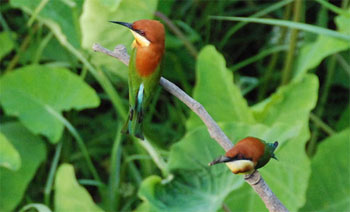
The Nagarjun hill forms the northwestern boundary of Kathmandu valley. The forests of Nagarjun has a royal retreat for members of the royal family and therefore was and remains a protected area. Although the slopes facing the city have sparse forests, its northwestern slopes still have dense forests. That side of the hill is also less explored and makes for great birding. The area does not hold as many species as the other hilly areas in the Kathmandu valley, but its unexplored areas might hold great surprises. The slopes facing the city are ideal for a couple of hours of bird watching. If one wants to explore the area more thoroughly, an entire day is needed. Take your lunch, and bottled water. The area can be covered on foot, though motorways are also present.Besides many of the birds of the other two hill forests of Kathmandu, the Nagarjun area also hosts birds such as the Northern Eagle Owl, Red-billed Blue Magpie, Long-tailed Mountain Thrush, Chestnut-headed Bee-Eater, Maroon Oriole, Large Hawk Cuckoo, and Eurasian Woodcock. The Brown Wood Owl has also been recorded here.

Shivapuri Bird Watching


Shivapuri National Park is one of the richest forested areas in the Kathmandu valley. The park has several entry points, the closest for Kathmandu dwellers being the army check point at Gairigaon, north of the Budhanilkantha Temple. The park is home to around 318 species of bird. That high number is not the only charming aspect of bird watching in Shivapuri, for the forests are relatively unexplored, especially the northern side, according to Suresh Shakya, who has studied the area’s birds for a long time. The potential for discovering new species is great in Shivapuri. It was here that Jochen Martin first discovered the Nepal Wren Babbler. The species was considered endemic to Nepal until recently when it was also recorded in India’s Corbett National Park. The forests hold a significant population of three restricted-range bird species: the Spiny Babbler, which is also Nepal’s only endemic bird, the Hoary-throated Barwing and the White-throated Tit. The park has a diverse vegetation; the lower slopes are now reduced to scrub, the upper slopes are covered in temperate forests. This diversity is reflected in the avifauna of the area, including the Hill Partridge, Great Barbet, Wedge-tailed Green Pigeon, Eurasian Jay, Kalij Pheasant, Nepal Fulvetta, Asian Paradise-Flycatcher, Rufous-bellied Woodpecker, Mountain Scops Owl and Grey-winged Blackbird. Birds of prey include various eagles, and a variety of robins, warblers and laughing thrushes are also found. Two globally threatened birds, the White-rumped Vulture and Hodgson’s Bushchat can also be seen. Shivapuri is a delight to all bird watchers who have an eye for exploration.

Chitwan National Park Bird Watching


The Chitwan National Park was established as the country’s first national park in 1973. The park is a valley with an area of 972 km2 in the country’s central lowland Terai. The park’s vegetation consists predominantly of Sal (Shorea robusta), a hardwood tree. Small areas of grasslands, tropical and pine forests are also found. The Lami, Tamar and Devi Tals are the most prominent among the several lakes and ponds in the floodplains of the three rivers that run through the park. The majority of threatened species of Nepali birds, about 59 percent, depend on forests for their survival. This makes Chitwan a bird haven, given that it is the largest tract of lowland forest in the country. Over half of Nepal’s total bird species are found in Chitwan, numbering 540 species. This number includes about two-thirds of the country’s globally threatened bird species. Several of the birds of Chitwan are found nowhere else in Nepal. The endangered grassland species, the Bengal Florican is a resident bird of Chitwan. The Grey-crowned Prinia, Slender-billed Babbler and the Lesser Adjutant inhabit the Chitwan grasslands. The park is the only known place in Nepal where the Slender-Billed Babbler is found and is believed to contain the largest population of the species in the Indian sub-continent. Understandably, in 1983 the Chitwan National Park was declared a World Heritage Site by UNESCO. The Indian Spotted Eagle, an endangered species breeds in Chitwan. The park also holds the highest number of Nepal’s near-threatened bird species – 15 out of 22. These include Ferruginous Pochard, Great Hornbill, Black-bellied Tern, Grey-headed and Lesser Fish Eagles, White-tailed Eagle, Cinereous and Red-headed Vultures, Pallid Harrier, Laggar Falcon, Darter, Painted and Black-necked Storks, Rufous-rumped Grassbird and Yellow-breasted Bunting. Other birds include Sarus Crane, Bengal and Lesser Floricans, Indian Skimmer, Pallas’s Fish Eagle, Jerdon’s Babbler and curlews. The Bar-headed Goose, a trans-Himalayan migrant, is seen near the Narayani river.

Koshi Tappu Wildlife Reserve Bird Watching


Bird watching in the Kathmandu valley is but a preview to Nepal’s extraordinary avifauna. The history of bird watching began in Kathmandu, but its presence in Nepal is in the Koshi Tappu Wildlife Reserve. The Koshi Tappu Wildlife Reserve is an assortment of habitats; its 17,500 hectares include grasslands or phantas, riparian vegetation, ox-bow lakes, marshes and sparse forests. To its south is the Koshi Barrage area, a seven kilometer by five kilometer strip of land, more than half of which is covered in water. This habitat is tailor-made for the migrating birds in Nepal. In 1987 the Koshi Tappu Wildlife Reserve became the first protected wetland in Nepal under the Ramsar Convention on Wetlands signed at Ramsar, Iran in 1971. The Koshi Tappu and Koshi Barrage areas are of international significance for birds and birders alike. More than 170 species of birds can be seen there in a day. The largest heronry in Nepal was recorded from the area, comprising of nearly 26,000 nests of 12 species of waders. There are records of 20 globally threatened species from the area. The Swamp Francolin, a globally endangered species has its highest numbers here. The area’s reputation as a bird haven is corroborated by the fact that it shelters 13 of Nepal’s 22 near-threatened bird species. A reading of ornithological journals and survey reports shows that the majority of new species of birds discovered in Nepal in the last ten years have been at Koshi Tappu. A week-long Bird Festival is organized annually by the people living around the reserve, commencing on the 2nd of February, which is the International Wetlands Day. During the festival indigenous cultural programs are organized along with bird watching trips that are free of cost for everyone, including tourists. A large number of Nepal’s birds, especially the ones in the country’s threatened list, are found in the lowlands. 55 percent of the country’s threatened species are found in the lowlands, within the altitudinal range of 75 to 1000 meters. Thus, the lowlands are inhabited by some of the rarest birds of Nepal.


 Contact us
mobile: +9779851123614


http://highgreenlaylandtravelsandlearn.yolasite.com/

Kathmandu, Bagmati, Nepal
Highgreen Leyland Travels and Learn is a travel business that sells travel related products and services to customers on behalf of suppliers such as airlines, car rentals, cruise lines, hotels, railways, sightseeing tours and package holidays that combine several products. In addition to dealing with ordinary tourists we have a separate department devoted to making travel arrangements for business travelers and we specialize in commercial and business travel only. If any foreign travel company would like to have as general sales agents for foreign travel companies, we will be very glad to have them.